Since coming into force in England, Wales, and Northern Ireland in February 2025, the Procurement Act 2023 has begun reshaping how Social Value is embedded, delivered and managed across public procurement. It has moved the focus from bid-stage Social Value commitments, to delivery, accountability and measurable outcomes across the full contract lifecycle.
In this breakdown, we explore what the Procurement Act 2023 means for Social Value in practice, for both contracting authorities and suppliers.
Table of contents
- Social Value legislation: A quick history lesson
- What is the Procurement Act 2023
- How the Procurement Act 2023 will unlock Social Value across the supply chain
- Contracting authorities: Social Value requirements under the Procurement Act 2023
- Suppliers: Winning work and demonstrating delivery under the Procurement Act 2023
- Don't know where to start with measuring Social Value?
- Extra resources
📖 Read: The Procurement Act 2023
🔗 Download: Our Procurement Act 2023 Bidder's Checklist
Social Value legislation: A quick history lesson
Before exploring the Procurement Act 2023, it’s worth understanding the legislative journey that brought Social Value into public sector procurement, and the limitations that made reform necessary.
The Public Services (Social Value) Act 2012
Public procurement represents hundreds of billions of pounds of government expenditure. Ensuring that this spending delivers tangible benefits for communities and the environment has been a core objective of procurement policy for more than a decade.
The first major push in this direction came with the Public Services (Social Value) Act 2012, which required public sector buyers to “consider” Social Value (alongside cost and quality) as part of procurement decisions.
While the Act was an important step, it set a light-touch duty, not defining how Social Value should be measured, weighted or managed, nor extending clearly into contract delivery. As a result, implementation varied widely.
To address this gap, the Social Value TOM System™ was developed in collaboration with the National Social Value Taskforce, giving authorities a standardised, outcome-led approach to measuring and reporting Social Value.
The Social Value Model
A further shift came in June 2020 with the introduction of:
- Procurement Policy Note (PPN) 06/20, in force from January 2021, requiring central government departments, executive agencies and non-departmental public bodies to apply a minimum 10% weighting to Social Value in tender evaluations
- The Social Value Model, providing a structured framework to help in-scope authorities assess Social Value at the tender stage
Together, these measures embedded Social Value more consistently into bid evaluation for central government contracts.
However, their scope remained limited. They applied only to in-scope authorities and focused primarily on commitments made at tender stage, rather than how those commitments were managed and delivered over the life of a contract.
What is the Procurement Act 2023?
The highly prescriptive rules of UK public procurement are designed to ensure fairness, transparency, and value for money. However, procurement teams have often been left feeling limited in their ability to design flexible contracts that deliver broader strategic outcomes, including Social Value.
In the wake of the UK’s departure from the European Union, the Procurement Act 2023 introduces a simpler, more transparent framework. It is designed to give contracting authorities greater flexibility to shape procurements around policy priorities, while improving accessibility for SMEs (small-medium enterprises) and VCFSEs (Voluntary, Community, Faith and Social Enterprises).
The Procurement Act is the biggest change we’ve had in procurement in over 30 years. We’re now stepping away from European-derived legislation that we’ve been very used to, and moving into a different environment.
Clive Higgins, UK Chair and CEO of Leonardo at the Social Value Conference
In the lead-up to the Procurement Act 2023...
-
Both the Social Value Act 2012 and the Social Value Model were updated to align with the new National Procurement Policy Statement.
-
PPN 001 was introduced to set procurement spend targets with SMEs and VCFSEs.
-
PPN 06/20 was superseded by PPN 002 for new procurements from February 2025 (read our PPN 002 guide here), and PPN 002 was itself superseded by PPN 026 in Aug 2026 (read our PPN 026 guide here)
These updates reflected a growing recognition that prior legislation had succeeded in elevating Social Value, but not in embedding it across the full contract lifecycle. The Procurement Act 2023 was designed to address exactly this gap.
Read the Government guidelines:
📝 PPN 001: SME and VCSE spend
📝 PPN 002: Social Value Model
📝 PPN 003: Social Value Act 2012
📝 PPN 026: New Social Value Model
How the Procurement Act 2023 unlocks Social Value across the supply chain
Here are some of the key ways that the Act has strengthened Social Value requirements in practice for public sector procurement:
Social Value in the National Procurement Policy Statement (NPPS)
Although the National Procurement Policy Statement is separate from Procurement Act 2023, contracting authorities are legally required to “have regard” to it under Section 13 of the Act. This significantly elevates its practical importance in procurement decision-making.
The NPPS itself strengthens the role of Social Value in three key ways:
Mission-driven procurement
The NPPS explicitly aligns public procurement with the Government’s five missions, stating that contracting authorities “should deliver social and economic value that supports the Government’s missions.”
This formalises an expectation that procurement decisions contribute to long-term national priorities, rather than focusing solely on short-term cost or output measures.
A place-based approach
Social Value has always been rooted in responding to local need. The NPPS reinforces this by requiring authorities to take account of local and regional economic growth plans when shaping procurements.
This encourages contracting authorities to move away from generic Social Value requirements and design contracts that respond to the specific economic, social, and environmental challenges facing their communities.
Contract management and delivery
Finally, the NPPS mirrors the Act’s focus on delivery. It makes clear that authorities should benchmark their procurement capability, ensure they have the capacity to manage contracts effectively, and prioritise long-term value for money – explicitly including Social Value.
What the National Procurement Policy Statement does is position procurement as a strategic enabler in achieving the government’s missions, and really sets out the vision for how public procurement can drive growth, Social Value, innovation.
Jennifer Pallister, Head of Commercial Implementation, Cabinet Office at the Social Value Conference
Authorities must “have regard to maximising public benefit”
Section 12 of the Procurement Act 2023 stipulates that, when awarding contracts, contracting authorities must “have regard to the importance of maximising public benefit”.
This is a significant shift from the Public Services (Social Value) Act 2012, which required authorities only to “consider” Social Value.
The Social Value Act says there is a duty to consider Social Value, which is a very light, low-level responsibility. With the new National Procurement Policy Statement, procurers will need to ‘have regard to’ certain priorities set out, which is a much higher legal test than ‘consider’. It means you have to unless you have a good reason not to.
Darren Knowd, Chief Executive of DRKNOWD at the Social Value Conference
This puts the onus on contracting authorities to demonstrate how public benefit has been factored into procurement decisions, and, where it has not, to justify that position.
From MEAT to MAT: A broader definition of ‘value’
For many years, public contracts were awarded to the Most Economically Advantageous Tender (MEAT) under the Public Contracts Regulations 2015, a model that often placed heavy emphasis on cost and technical compliance.
Section 19 of the Procurement Act 2023 updates this principle, allowing contracting authorities to award contracts based on the Most Advantageous Tender (MAT) instead.
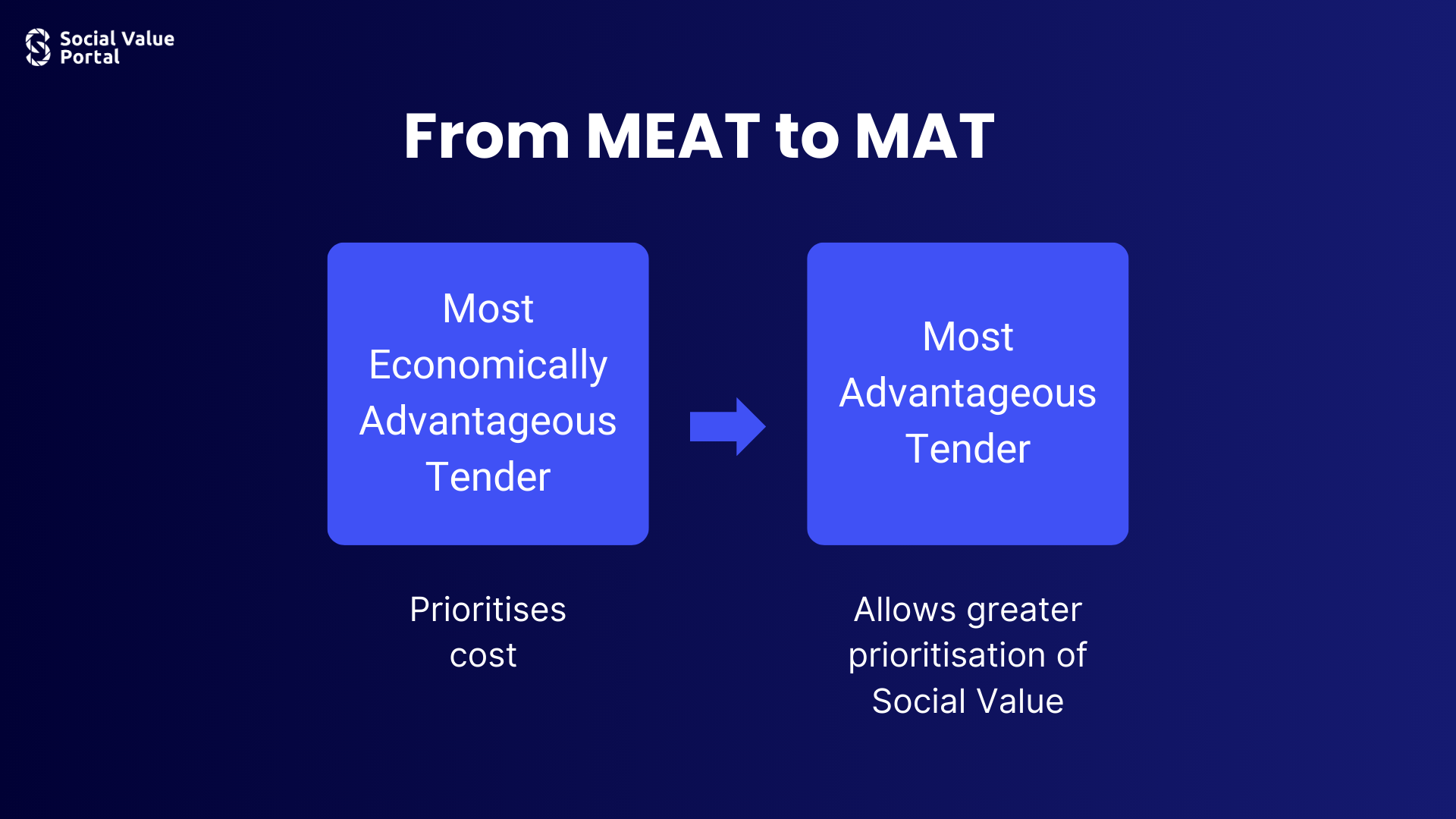
This change gives authorities greater flexibility to define what “advantageous” means in the context of their objectives. Their procurement decisions can now reflect broader public benefit alongside price and quality, such as:
- Local job creation and apprenticeships
- Sustainability and environmental impact
- Supplier diversity and SME participation
From targets to delivery: Stepping up transparency and reporting
The Procurement Act 2023 introduces a stronger emphasis on transparency and delivery through a set of clear reporting requirements, including setting and publishing Key Performance Indicators (KPIs), as well as performance against those KPIs (more detail on this later).
These requirements respond to a long-standing issue in public procurement: while Social Value commitments are often clearly articulated at tender stage, they have not always been managed consistently once contracts are live.
While many procurement processes are robust at the outset, they often fall short in ongoing contract oversight. The Act’s emphasis on improved contract management is therefore a welcome shift.
Alison Ramsey, Senior Social Impact Manager, SCAPE at the Social Value Conference
Public reporting and the risk of exclusion
The Act also introduces stronger consequences for persistent non-delivery, including a public debarment list that can exclude suppliers from future government contracts.
However, this is not intended as a punitive measure. As Ben Pollard clarified at the Social Value Conference:
Exclusion powers cannot be used to punish suppliers for poor performance. However, they can be used to mitigate the risk of future contractual non-compliance. So, if you believe that historic noncompliance on Social Value KPIs may carry forward, that's when you would use this mechanism… Crucially, this supplier also needs to be given a proper opportunity to improve performance.
Ben Pollard, Marketing Executive, Tussell at the Social Value Conference
SMEs & VCFSEs: New opportunities in public procurement
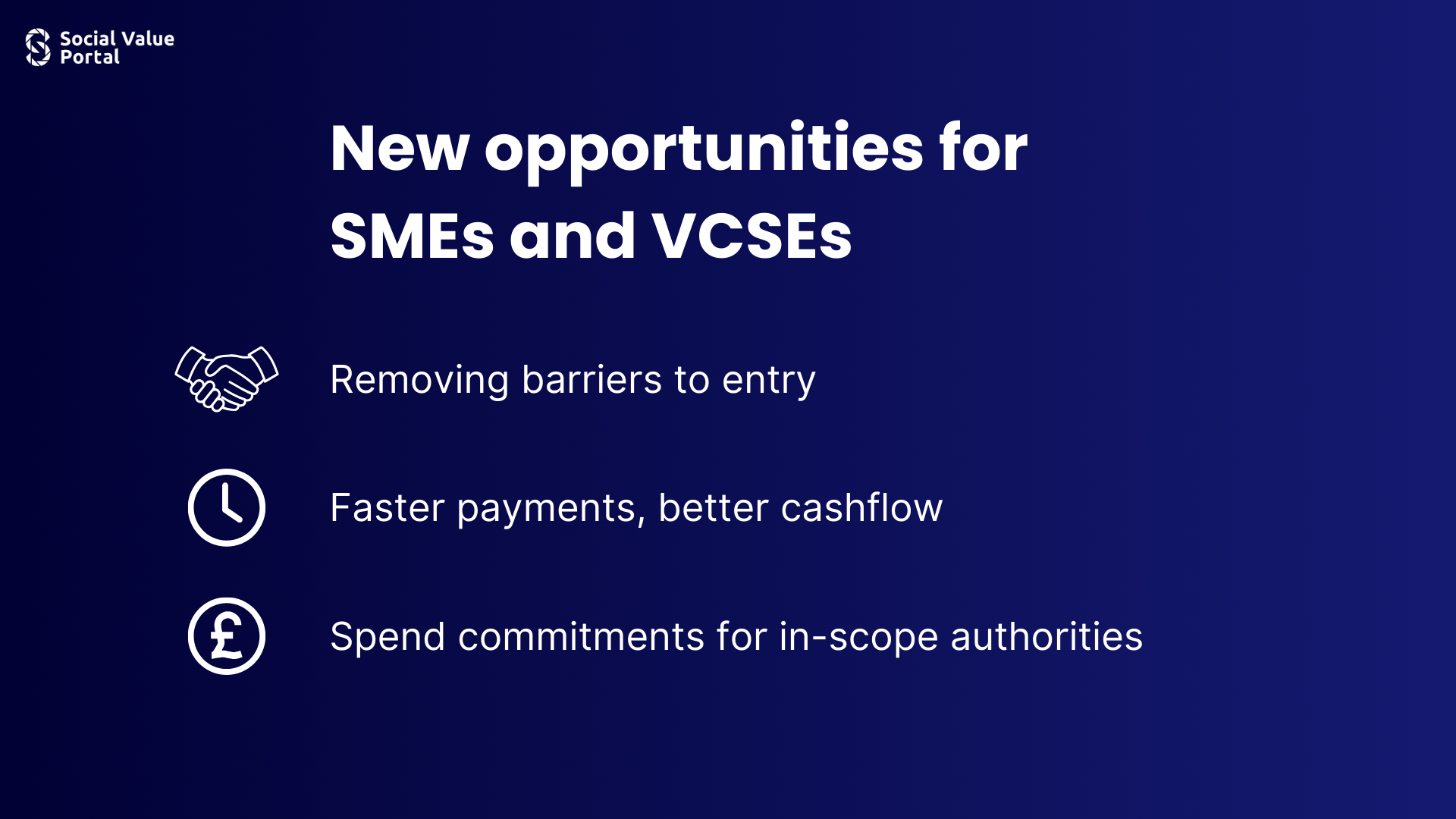
A core objective of the Procurement Act 2023 is to make public procurement more accessible to SMEs and VCFSEs.
To support this, the Act introduces measures designed to remove long-standing barriers to entry, including:
- A duty on contracting authorities to have regard to barriers faced by SMEs and consider whether those barriers can be removed or reduced
- Strengthens the requirement for 30-day payment terms across public sector supply chains, improving cash flow and financial resilience for SMEs and VCFSEs
Alongside the Act, the NPPS and PPN 001 introduce new expectations around spend with smaller suppliers. Under PPN 001, ‘In-scope’ authorities are required to set spend targets for SMEs and VCFSEs, while central government departments must:
- Set a three-year SME spend target (from April 2025)
- Set a two-year VCFSE spend target (from April 2026)
- Report performance against these targets annually
Next, we look at the practical changes in depth and how they impact both contracting authorities and suppliers to the public sector.
Contracting authorities: Social Value requirements under the Procurement Act 2023
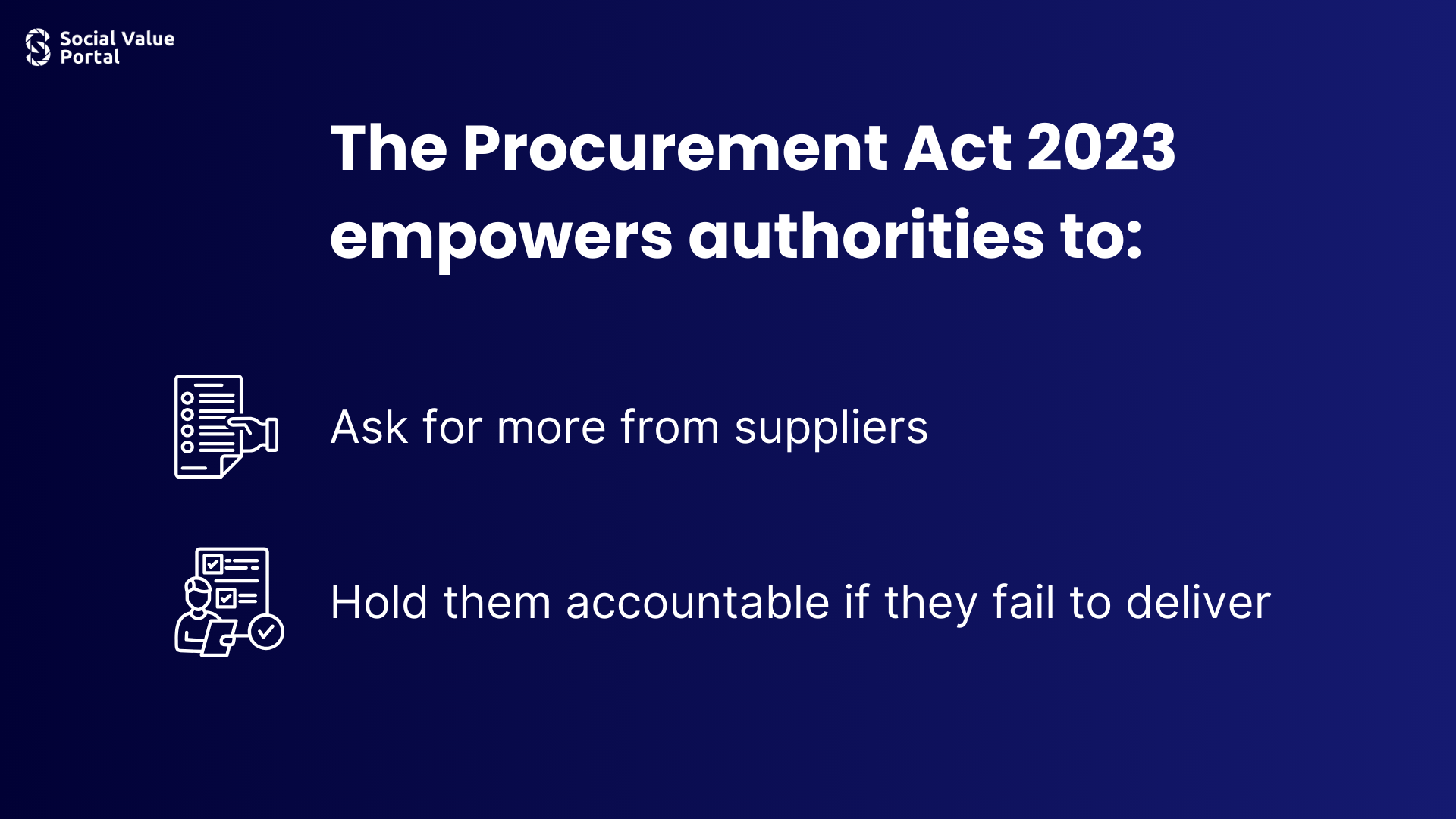
If you’re a contracting authority, then the Procurement Act 2023 does two key things:
- It empowers you to ask for more from your suppliers
- It introduces new legal responsibilities to ensure commitments are actively delivered
In 2026, experience under the Act is reinforcing an important reality: stronger Social Value outcomes depend not just on what is asked for in bids, but on how procurements are managed throughout the contract lifecycle.
Here’s how contracting authorities are maximising Social Value from their supply chains while aligning with Government policy objectives:
Preliminary market engagement
The Procurement Act 2023 places greater emphasis on early market engagement, giving suppliers earlier visibility of upcoming opportunities, and allowing authorities to shape procurements in collaboration with the market.
The key obligations are straightforward: if PME is carried out, a Preliminary Market Engagement Notice (UK2) must be published on Find a Tender before the Tender Notice. If it isn't carried out, the Tender Notice itself must explain why.
The new prominence of preliminary market engagement under the Procurement Act is showing up in notice volumes. At the Social Value Conference in October 2025, procurement expert Darren Knowd noted that 27,000 notices had already been issued since the Act had gone live, with the majority being Preliminary Market Engagement notices. This signals a real shift towards earlier market engagement.
Effective tools for preliminary market engagement include:
- Meet the buyer events: Introduce suppliers to upcoming tenders and clarify your Social Value expectations.
- Request for Information (RFI) or Prior Information Notices (PINs): Assess market capacity and gather insights into the supply base before drafting your tender.
- Supplier questionnaires and surveys: Understand supplier capabilities and potential barriers.
- Local Needs Analysis: Conduct data-driven research into community challenges and provide suppliers with access to the information to help them refine their bids.
Authorities should be explicit at tender stage about the importance placed on Social Value, including the evaluation weightings applied and how delivery will be monitored once the contract is awarded.
If suppliers have had previous experience where follow-up isn’t really there, they can believe they can promise a lot at bid stage and not necessarily be held to account. What I’ve seen is that the greatest successes are where there’s resource to work closely with suppliers – holding them to account, but also supporting and assisting them to deliver.
Tim Rudin, Head of Central Responsible Procurement Team, Greater London Authority Group at the Social Value Conference
💡 Tip: Create and publish a Social Value Policy to guide bidders!
Balance cost with long-term public benefit in evaluations
The shift from Most Economically Advantageous Tender to Most Advantageous Tender, alongside the NPPS’s emphasis on long-term value aligned with local and regional growth plans, gives contracting authorities greater flexibility to balance cost with wider public benefit when awarding contracts.
For example, where a local area faces limited access to green space or low youth employment, MAT criteria can be used to prioritise bids that demonstrate credible, contract-relevant plans to address those challenges, such as investment in public spaces or the creation of apprenticeships.
Set clear and enforceable Social Value targets
Experience prior to the Procurement Act 2023 showed that strong evaluation criteria alone were not always enough to guarantee delivery. The Act addresses this gap by strengthening transparency, reporting, and contract management requirements.
Contracting authorities must:
- Set at least three Key Performance Indicators for public contracts valued over £5 million
- Publish KPI information in accordance with the Act’s transparency requirements and publish supplier performance against them at least annually
- Publish a Contract Performance Notice where the supplier has failed to perform
- Enforce contractual obligations where delivery falls short, using proportionate contractual remedies
If you are asking for anything at the procurement stage, and you are turning it into a differentiator, put it in your contract terms and make it stick through the commercial lifecycle. If the only reason someone has won a contract is on the basis of its Social Value response, then make sure that they can lose the contract for failure to deliver that, or reimburse you.”
Rebecca Rees, Head of Public Procurement, Trowers & Hamlins at the Social Value Conference
How Social Value performance against KPIs is rated
Assessments must use the standardised five-point rating scale set out in Regulation 39(5) of the Procurement Regulations 2024:
|
Rating
|
What it means
|
|
Good
|
Performance is meeting or exceeding the KPI
|
|
Approaching Target
|
Performance is close to meeting the KPI
|
|
Requires Improvement
|
Performance is below the KPI
|
|
Inadequate
|
Performance is significantly below the KPI
|
|
Other
|
Performance cannot be described by any of the above
|
These ratings are published on Find a Tender and become part of a supplier's public track record, creating a practical incentive for suppliers to address underperformance without the authority needing to invoke formal remedies at all.
For the ratings to work as intended, the thresholds that define each band need to be agreed before the contract starts. And while there is more than one way to build a Social Value KPI, our recommendation is to use a value-based measurement approach:
Designing Social Value KPIs: Value-based measurement
- How it works: Measures Social Value delivery against the total financial proxy value committed by the supplier at tender stage. This is the approach underpinning the TOM System, which assigns financial proxy values to Social Value activities.
- Example: If a supplier committed to £300,000 of Social Value for the year and delivered £285,000 worth, that represents 95% delivery, a "Good" rating. If they delivered only £90,000, that would be "Inadequate."
- Advantages: Naturally prioritises the highest-value Social Value measures, making it harder for suppliers to game their rating by over-delivering on minor commitments.
- Considerations: Where contracting authorities are required to use a qualitative-only methodology at evaluation stage, the financial proxy values must be agreed and applied post-award rather than used in evaluation itself.
💡 For detailed guidance, read our dedicated report: KPIs under the Procurement Act 2023
Contract Performance Notices: What happens when a supplier underperforms?
If a supplier fails to perform to a serious degree, the Procurement Act 2023 requires the contracting authority to publish a Contract Performance Notice (CPN).
A CPN explains what went wrong and the circumstances surrounding the failure. Once published, it is publicly visible to other contracting authorities in future procurements.
Termination remains a contractual remedy, and debarment requires a Ministerial decision. However, a published CPN can still have meaningful reputational and commercial consequences. For that reason, any decision to issue one must be properly evidenced and defensible.
In practice, most situations should begin with dialogue. Authorities should seek to understand the causes of underperformance and agree corrective action where possible. If performance does not improve within a clear rectification period, formal remedies, including a CPN, may follow.
Build capability to deliver Social Value
The National Procurement Policy Statement makes clear that building capability for Social Value delivery is a key priority, stating that:
Contracting authorities should ensure the right commercial capability and standards are in place to procure and manage contracts effectively and to collaborate with other contracting authorities to deliver best value.
Experience to date suggests that where Social Value delivery falls short, this is rarely due to a lack of ambition. More often, it reflects constraints on time, resource and contract management capacity.
Contracting authorities looking to strengthen their Social Value delivery capabilities should consider a combination of approaches:
- Invest in skills and training
- Strengthen internal processes and systems
- Collaborating with third party Social Value experts to extend capacity
Suppliers: Winning work and demonstrating delivery under the Procurement Act 2023
With greater transparency across procurement pipelines, it’s now easier for suppliers to align bids to local priorities and authorities’ Social Value objectives.
At the same time, the Procurement Act 2023 strengthens supplier accountability. Authorities now have clearer powers to manage poor performance, address unethical behaviour and, in some circumstances, exclude suppliers that fail to deliver against their commitments.
Here’s what suppliers need to focus on to win work and remain compliant under the Act.
Engage early with buyers
The Act has increased transparency through pipeline and transparency notices, giving suppliers earlier sight of upcoming opportunities. The Act also introduces the Central Digital Platform, a single searchable system where regulated procurement notices must be published.
To stay ahead, suppliers should:
- Track authorities’ published pipelines and upcoming tenders
- Engage early to understand Social Value priorities before bids are issued
- Attend meet-the-buyer events and review published Social Value policies and strategies
Make clear, deliverable Social Value commitments in bids
Under the Procurement Act 2023, Social Value continues to play a key role in evaluations.
The weighting for Social Value is increasing and quite consistently now at 20%. It is becoming in many instances the determining factor in who wins a contract.
Terry Brewer, Head of Public Sector Delivery, Social Value Portal
To stand out, Social Value commitments in bids should be:
- Aligned to documented community needs and authority priorities
- Specific, measurable and time-bound (for example, a defined number of apprenticeships over a set period)
- Clearly attributable to the scope of the contract
- Additional to core business activity and contractual minimums
- Realistic, with clear metrics to support ongoing delivery and reporting
Experience to date shows that bids which over-promise without a credible delivery plan carry greater risk under the new regime.
💡 Give yourself a boost with extra bid support
Prepare for increased scrutiny and reporting obligations
As covered, under Sections 52 and 71 of the Procurement Act 2023, contracting authorities must publish at least three Key Performance Indicators for contracts worth over £5 million. Where Social Value KPIs are included, suppliers should expect to report regularly on delivery throughout the contract lifecycle.
This means suppliers with a strong, evidenced track record of Social Value delivery supported by reliable data are likely to be better placed in future competitions. Transparency cuts both ways: it increases scrutiny, but it also creates an opportunity to differentiate based on delivery.
Don’t know where to start with measuring Social Value?
As transparency and reporting expectations increase under the Procurement Act 2023, organisations need a consistent way to define, track and evidence Social Value delivery across bids, contracts and supply chains.
The Social Value TOM System™ provides a standardised, outcomes-led framework for measuring and reporting Social Value, taking the hard work out of creating trackable Social Value metrics in tenders, bids and contracts.
All data publicly reported using the TOM System undergoes third-party validation – ensuring transparent, accurate reporting to avoid greenwashing or social-washing claims.
Adrian Williams from London Borough of Waltham Forest, on third-party validation and the TOM System
Resources to help you deliver Social Value under the Procurement Act 2023
With the Procurement Act 2023 in force, the priority is embedding Social Value into evaluation, contract management, and reporting in a way that is measurable and impactful.
Whether you’re a supplier or an authority, our resources will get you started:
🔗 Contracting authorities: Benchmarking Social Value in procurement
🔗 Suppliers: Procurement Act 2023 Bidder’s Checklist

.svg)